“In the 2023 Global Hunger Index, India ranks 111th out of the 125 countries with sufficient data to calculate 2023 GHI scores. With a score of 28.7 in the 2023 Global Hunger Index, India has a level of hunger that is serious.” – https://www.globalhungerindex.org/india.html (Date accessed: 6 March 2024) | Related posts >>
National Family Health Survey on dairy products and vitamin-A-rich fruits
New Delhi: A UN estimate has raised questions about the Indian government’s figures on food assistance needs. The UN report, released this week, suggests that over a billion people in India couldn’t afford a healthy diet in 2021, contradicting the government’s claim that only 813 million people require food assistance. […]
According to the 2023 report on food security and nutrition by five UN agencies, 74.1% of Indians, approximately 1.043 billion people, were unable to afford a healthy diet in 2021. The report also estimated India’s proportion of undernourished population at 16.6% during 2020-2022. […]
A study based on the National Family Health Survey 2021 found that among the poorest 20% households, more than 40% of women, even pregnant women, did not consume dairy products. It also found that over 50% of women and 40% of men in the country did not consume vitamin-A-rich fruits. […]
S.V. Subramanian, professor of population health and geography at Harvard University, who led the study, said the Union’s [Government’s] own count of 813 million people needing food aid was a “bit of a surprise” because “it seems larger than what is suggested by conventional measures of undernutrition,” the Telegraph report said. […]
Source: “‘Over 74% Indians Unable to Afford Healthy Diet’: UN Report” by Wire Staff, 15 December 2023
URL: https://thewire.in/rights/over-74-indians-unable-to-afford-healthy-diet-un-report
Date Visited: 6 March 2024
“In the 2022 Global Hunger Index, India ranks 107th out of the 121 countries with sufficient data to calculate 2022 GHI scores. With a score of 29.1, India has a level of hunger that is serious.” – https://www.globalhungerindex.org/india.html (Date accessed: 22 October 2022)
Source: 2022 Global Hunger Index
URL: https://www.globalhungerindex.org/india.html
Date Visited: 30 June 2022
Related posts >>
Legally entitled to a full stomach
Fifty percent of the world’s hungry live in India [2012 estimates, see globalhungerindex.org for more recent figures]. But India is a democracy, which gives her citizens a lot of rights – for instance, the constitutional right to food. Based on this right, Indian civil society organisations won a series of court battles in the name of the poor. Now a Right to Food Bill is about to be passed. Will this be the end of malnutrition and starvation in India? […]
The Bill is expected to result in multiple advantages like providing food to the hungry, reducing the child mortality rate and improving the public distribution systems. But there are several practical and theoretical aspects that could threaten the success. A practical issue is the identification of the priority groups. Who exactly is below the poverty line is a matter of controversy.
Not all state governments in India have clear criteria for defining the persons in need, and the central government uses parameters based on a survey conducted in the year 2002. It is extremely difficult to differentiate who belongs to BPL-group only through certain laid down criteria. Even if the criteria work, it is hard to ignore the recommendation and influence of political and caste-creed leaders who still play a decisive role in village politics. Another potential difficulty lies in including seasonal migrated laborers or Adivasi (India’s marginalised tribal people) in remote areas, who are often excluded from government help schemes because of their geographical location and way of life. […]
There are also theoretical questions to the Food Bill, such as: What will be the consequence regarding the moral and psychological attitude of people who grow up with subsidised food? Is it morally correct to feed more than half the country’s population by government funds, and for how long? Does it not undermine the human potential and contradict the basic principal of human development, namely, to “help people to help themselves”? Can anyone really live in dignity, eating subsidised food? Such questions might seem insensitive to hungry people, but they matter.
However, preventing hunger is certainly a priority. It is a bitter irony to call India one of the fastest growing economies in the world, while half of her population suffer malnutrition. But before implementing the bill, it is necessary to build up enough food storage, an efficient and transparent public distribution system and an administration with accountability. There should be a mechanism to inform villagers about the rules and regulations of the bill and how to get hassle-free service. Not only the institution of the Panchayati Raj (the elected village councils that serve as the lowest tier of the government), but also rural-level NGOs and the traditional social structures of Adivasis in remote areas can play a vital role in disseminating the government’s ideas and policies. […]
Source: “Indian government wants to enforce right to food with new legislation” by Boro Baski – Development and Cooperation (D+C) – International Journal
Address : http://www.dandc.eu/articles/220367/index.en.shtml
Date Visited: Tue Mar 27 2012 09:14:09 GMT+0200 (CEST)
Dr. Boro Baski works for the community-based organisation Ghosaldanga Adibasi Seva Sangha in West Bengal. The NGO is supported by the German NGO Freundeskreis Ghosaldanga und Bishnubati. He was the first person from his village to go to college as well as the first to earn a PhD (in social work) at Viswa-Bharati. This university was founded by Rabindranath Tagore to foster integrated rural development with respect for cultural diversity. The cooperation he inspired helps local communities to improve agriculture, economical and environmental conditions locally, besides facilitating education and health care based on modern science.
He authored Santali translations of two major works by Rabindranath Tagore, the essay “Vidyasagar-Charit” and the drama Raktakarabi (English “Red Oleanders”), jointly published by the Asiatic Society & Sahitya Akademi (India’s National Academy of Letters) in 2020.
Other posts contributed by Dr. Boro Baski >>
Ghosaldanga Bishnubati Adibasi Trust
Registration under Trust Registration Act 1982
P.O. Sattore, Dist. Birbhum
West Bengal-731 236
India
For inquiries on Santal cultural and educational programs, please contact:
Mob. 094323 57160 or [email protected]
Up-to-date reports by Indian experts and journalists
Search tips
Combine the name of any particular state, language or region with that of any tribal (Adivasi) community.
Add keywords of special interest (health, nutrition endangered language, illegal mining, sacred grove); learn about the rights of Scheduled Tribes such as the “Forest Rights Act” (FRA); and the United Nations “Declaration on the Rights of Indigenous Peoples”, “Universal Declaration of Human Rights”, “women’s rights”, or “children’s right to education”.
Specify any other issue or news item you want to learn more about (biodiversity, bonded labour and human trafficking, climate change, ecology, economic development, ethnobotany, ethnomedicine, global warming, Himalayan tribe, hunter-gatherers in a particular region or state, prevention of rural poverty, water access).
For official figures include “scheduled tribe ST” along with a union state or region: e.g. “Chhattisgarh ST community”, “Scheduled tribe Tamil Nadu census”, “ST Kerala census”, “Particularly Vulnerable Tribal Group Jharkhand”, “PVTG Rajasthan”, “Adivasi ST Kerala”, “Adibasi ST West Bengal” etc.
In case the Google Custom Search window is not displayed here try the following: (1) toggle between “Reader” and regular viewing; (2) in your browser’s Security settings select “Enable JavaScript” | More tips >>
List of websites covered by this Google custom search engine
Academia.edu (platform for academics to share research papers) – www.academia.edu
Archive.org – https://archive.org
Centre for Science and Environment – https://www.cseindia.org
Current Conservation – https://www.currentconservation.org
Development and Cooperation (D+C) https://www.dandc.eu
Down To Earth (India) – www.downtoearth.org.in
India Environment Portal – www.indiaenvironmentportal.org.in
Harnessing Nature Magazine – https://harnessingnature.online
Mongabay-India – https://india.mongabay.com
M S Swaminathan Research Foundation – www.mssrf.org
Navdanya (protecting India’s biodiversity based food heritage) – https://navdanya.org
Third World Network (Penang, Malaysia) – https://twn.my
The Shola Trust (nature conservation in the Nilgiri region) – www.thesholatrust.org
Research the above issues with the help of Shodhganga: A reservoir of theses from universities all over India, made available under Open Access >>
Note: hyperlinks and quotes are meant for fact-checking and information purposes only | Disclaimer >>
[…] There was a time when Adivasi communities in the Nilgiris had easy access to food from the forests. “Adivasis are extremely knowledgeable about the tubers, berries, leafy greens and mushrooms which they collect,” says Mari Marcel Thekaekara, who has been working with Gudalur’s tribal communties for four decades. “They would also fish and hunt small animals for food throughout the year. Most homes would have some meat drying above the cooking fires for a rainy day. But then the forest department began limiting their entry into the forests and finally stopped it completely.” […]
Despite the restitution of community rights over common property resources under the Forest Rights Act of 2006, the Adivasis are not able to supplement their diet with resources gathered from the forest as they did before. The falling incomes in village here are also contributing to the growing malnutrition.
Source: “In the Nilgiris, an inheritance of malnutrition” by Priti David (People’s Archive of Rural India, 1 May 2020)
URL: https://ruralindiaonline.org/en/articles/in-the-nilgiris-an-inheritance-of-malnutrition/
Date Visited: 11 October 2021
Read more posts by Mari Marcel Thekaekara >>
“Doctors in the region [Palakkad district] argue that while the proportion of people with mental illnesses is not unusually high, the problem is a crisis because of their socioeconomic vulnerability.” […] “The non-inclusivity of Adivasis is nothing but racial discrimination. Adivasis were always ruled.” | In-depth analysis (Scroll.in 5 April 2023) >>
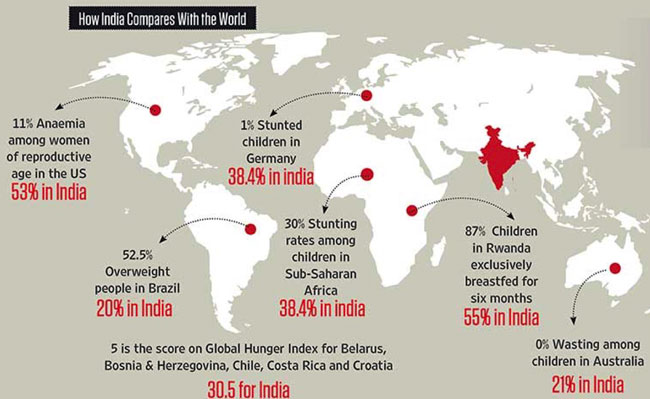
Graphic © Outlook India 26 August 2019 | Enlarge >>
“The tribal food basket has always been diverse and nutritious” >>
“Health spending by the Indian government as percentage of GDP has long been one of the lowest for any major country, and the public health system is chronically dismal.” – Pranab Bardhan in “The two largest democracies in the world are the sickest now” | Learn more: Scroll.in, 24 August 2020 >>
World Inequality Report 2022
India
Pop. 1,393,409,000 (2021)Extreme income inequalities in India
The average national income of the Indian adult population is €PPP7,400 (or INR204,200).* While the bottom 50% earns €PPP2 000 (INR53,610), the top 10% earns more than 20 times more (€PPP42 500 or INR1,166,520). While the top 10% and top 1% hold respectively 57% and 22% of total national income, the bottom 50% share has gone down to 13%. India stands out as a poor and very unequal country, with an affluent elite.
*€1 PPP = $PPP 1.4 = INR 27.5
Income inequality in the long run: a historical high
Indian income inequality was very high under British colonial rule (1858-1947), with a top 10% income share around 50%. After independence, socialist-inspired five-year plans contributed to reducing this share to 35-40%. Since the mid- 1980s, deregulation and liberalization policies have led to one of the most extreme increases in income and wealth inequality observed in the world. While the top 1% has largely benefited from economic reforms, growth among low and middle income groups has been relatively slow and poverty persists . Over the past three years, the quality of inequality data released by the government has seriously deteriorated, making it particularly difficult to assess recent inequality changes.
Average household wealth in India is equal to €PPP35,000 or INR983,010 (compared with €PPP81,000 in China). The bottom 50% own almost nothing, with an average wealth of €PPP4,200 (6% of the total, INR66,280). The middle class is also relatively poor (with an average wealth of only €PPP26 400 or INR723,930, 29.5% of the total) as compared with the top 10% and 1% who own respectively €PPP231,300 (65% of the total) and over €PPP6.1 million (33%), INR6,354,070, and INR32,449,360.
Gender inequality
Gender inequalities in India are very high. The female labor income share is equal to 18%. This is significantly lower than the average in Asia (21%, excluding China). This value is one of the lowest in the world, slightly higher than the average share in Middle East (15%). The significant increase observed since 1990 (+8 p.p.) has been insufficient to lift women’s labor income share to the regional average. […]
Source: Country appendix, World Inequality Report 2022
URL: https://wir2022.wid.world/country-appendix-glossary/
Date Visited: 30 June 2022
[Bold typeface added above for emphasis]
The World Inequality Report 2022 has shed light on starkly growing inequalities in India. But, under the present regime, there has been a subversion of discourse required to address these yawning material and social chasms. […]
But what is ironic is that this imagined religious community is riven by drastic inequalities which show no sign of relenting. In fact, the so-called spiritual communion is not only indifferent to the lot of the most marginalised and vulnerable, but it also becomes a mask to hide the temporal and material hierarchy.
The bottom 50% earns only an average annual income of Rs 53,610, whereas the top 10% earns 22 times more than that (one of the highest gaps in the world), according to the recently released World Inequality Report 2022. In the least unequal nations, the gap is merely in the range of six to eight times. […]
India’s worrying ranking in the Global Hunger Index: 101 out 116 (and behind Bangladesh, Nepal and Pakistan). […]
Dalits, Most Backward Castes, and Adivasis face staggering levels of dispossession and the brunt of economic downturns. In another study (between 2015-17), 22% Hindu upper castes owned 41% of total assets, while 24% of Hindu Dalits and Adivasis owned only 11%. […]
Source: “How Hindu Nationalism Enables India’s Slide Into Inequality” by Nissim Mannathukkaren (Dalhousie University, Canada), The Wire, 28 December 2021
URL: https://m.thewire.in/article/communalism/how-hindu-nationalism-enabled-indias-slide-into-inequality
Date Visited: 30 June 2022
Tips for using interactive maps
Toggle to normal view (from reader view) should the interactive map not be displayed by your tablet, smartphone or pc browser
For details and hyperlinks click on the rectangular button (left on the map’s header)
Scroll and click on one of the markers for information of special interest
Explore India’s tribal cultural heritage with the help of another interactive map >>
See also
Adverse inclusion | Casteism | Rural poverty
Demographic Status of Scheduled Tribe Population of India (Census figures 2011)
Fact checking | Figures, census and other statistics
Human Rights Commission (posts) | www.nhrc.nic.in (Government of India)
Search tips | Names of tribal communities, regions and states of India
“What is the Forest Rights Act about?” – Campaign for Survival and Dignity
“Who are Scheduled Tribes?” – Government of India (National Commission for Scheduled Tribes, NCST)

“India, a union of states, is a Sovereign, Secular, Democratic Republic with a Parliamentary system of Government. The President is the constitutional head of Executive of the Union. In the states, the Governor, as the representative of the President, is the head of Executive. The system of government in states closely resembles that of the Union. There are 28 states and 8 Union territories in the country. Union Territories are administered by the President through an Administrator appointed by him/her. From the largest to the smallest, each State/UT of India has a unique demography, history and culture, dress, festivals, language etc. This section introduces you to the various States/UTs in the Country and urges you to explore their magnificent uniqueness…” – KnowIndia (Government), States and Union Territories (Visited: 2 September 2023)
Learn more about India’s 28 States and 8 Union Territories – From Andhra Pradesh to West Bengal | Nutrition >>